Politics is a key factor in the economy. Step one of macro forecasting is to determine your baseline assumptions, of which the political environment is critical.
Prediction: Conservative majority
Rationale and observations:
UK political parties can loosely be divided along the traditional ‘Left-Right’ axis, and with an addition ‘Leave-Remain’ axis. While one can debate exactly where parties should lie on this spectrum and the extent to which they may overlap, there are two clear points to draw from the image below.
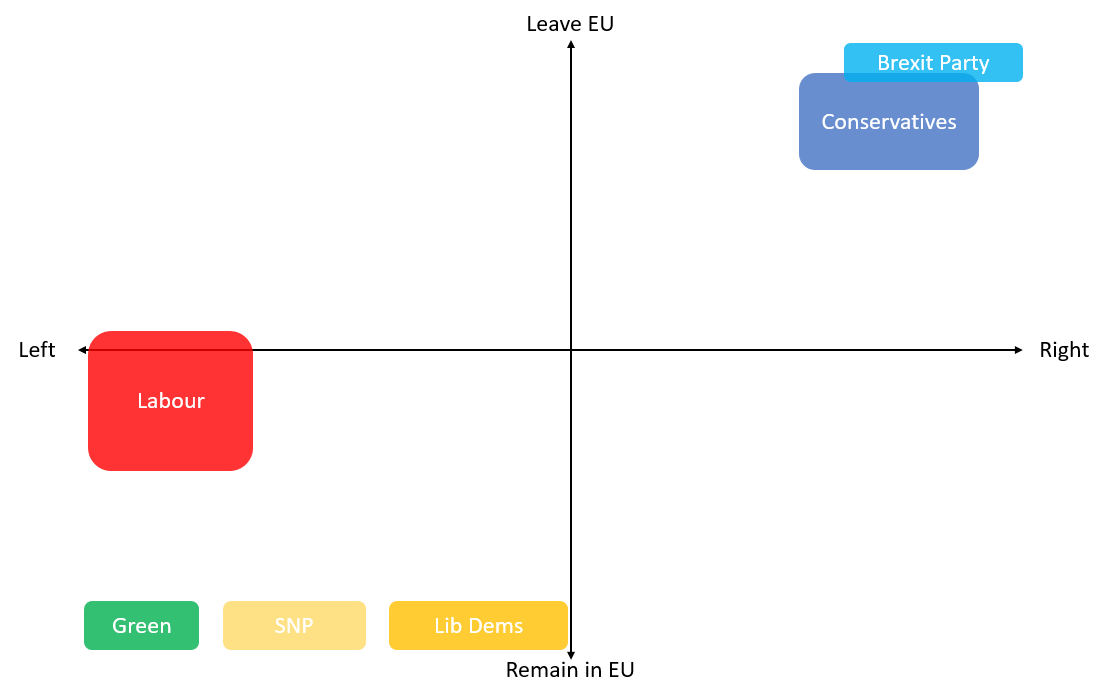
First, there are two quadrants which are not covered by any major political party. This is really the crux of this election, and the basis of Boris’ election strategy. Left-leaning Brexit-supporters – the typical working-class ‘Wigan Man’ stereotype – are essentially being asked to decide whether to prioritise Brexit preferences over socio-political preferences. Boris is gambling that they will do just that. This means either voting Conservative, or if they cannot bring themselves to vote Conservative (many are life-long Labour voters of which many are proud) then either voting Brexit Party or perhaps voting with their bottoms – they will not vote. For what it’s worth, I suspect that this gamble will work and that turnout in Leave-voting labour strongholds will be low. Right-leaning ‘Remainers’ are a much smaller share of the population and critically from an election perspective, more dispersed. Turnout is also likely to be small among this group, with the Liberal Democrats probably the least objectionable party.
The second observation is that there has been a near abandonment of the centre. This has been well-covered so I won’t dwell on it much, but I think it is quite stark. There are a few minor centrist parties, but even the Lib Dems have abandoned their stance of moderation with their switch to a policy of Revocation of A.50. This appears to have alienated many of their more casual supporters who find this too extreme a stance – and a particularly unnecessary one given that they were never going to be in a position to introduce it anyway. Labour have taken a centrist stance on Brexit, though not on the Left-Right axis.
This election is a real missed opportunity for Labour. Clearly the current Labour party membership does not want a centrist party at present – fair enough, it is their party and they can do with it as they wish. Yet one cannot help but feel that were they to shift even a few degrees closer to the centre, they would stand a reasonably good chance at winning a majority against a deeply unpopular Conservative government. Alas, there appears to be little/no evidence of such a shift, hence my prediction of a Conservative majority. It is ironic in a way. The insistence on a ultra-hard left platform is perhaps the thing more than any other which will lead to a Conservative/Right government for the next five years.
PS. Apologies to TIG, PC, ChangeUK (if you still exist), Lord Buckethead, Count Binface and others I omitted. The size of the boxes does not meant anything other than I did it quickly, though perhaps a psychologist may wish to suggest some latent biases in there. Feel free to disagree about where I have placed the boxes.
PS2. I recommend Electoral Calculus for converting General Election polls into seat predictions with a reasonably robust methodology.
 Political Economy